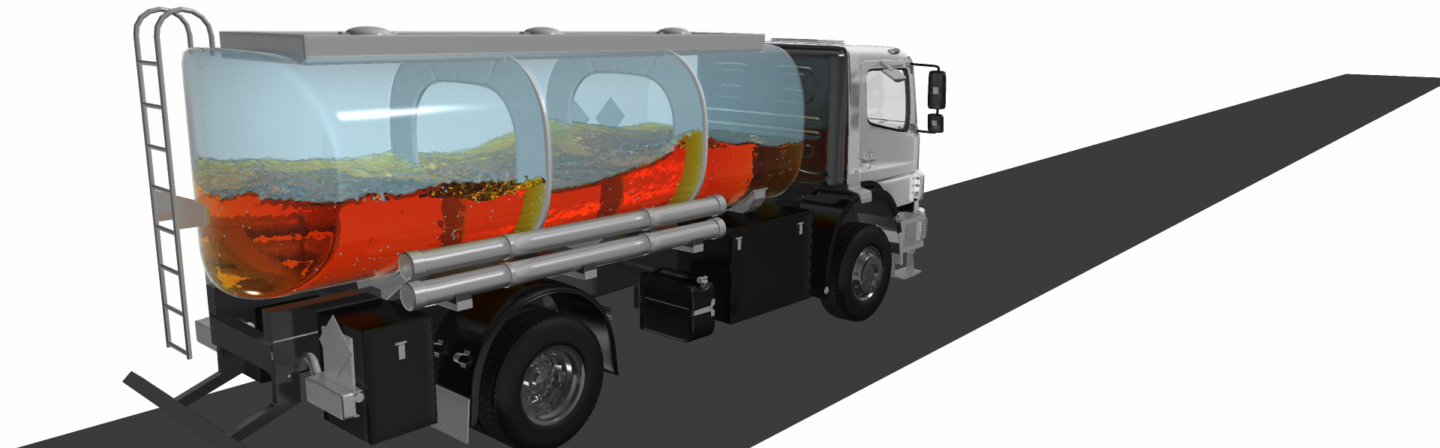
Tank sloshing refers to the movement of liquid inside a tank, which occurs during vehicle maneuvers such as acceleration, braking, or cornering. This phenomenon poses significant concerns in the automotive and transportation industries, where tanks carry fuel, chemicals, and other fluids. The movement of liquid inside the tank may cause large forces and moments, leading to various issues.
In vehicles, the primary challenges posed by tank sloshing extend beyond stability and include impacts on vehicle performance, fuel efficiency, and safety. Uncontrolled sloshing can generate large forces and moments acting on the tank, leading to irregular handling, degradation of driving dynamics, and increased mechanical fatigue on both the tank and its mounting systems. Additionally, the movement of the fluid can generate pressure surges that stress the tank walls, potentially leading to leaks or structural failures. Addressing these challenges requires a detailed analysis and innovative design solutions to predict and mitigate the effects of sloshing effectively.
PreonLab’s pure particle-based method is an advanced approach for tackling these challenges. By virtualizing tank sloshing development, this method significantly reduces the need for physical prototyping, saving both time and costs. It enables faster and efficient design iterations, leading to more robust and optimized tank designs.
Tank sloshing simulations can provide valuable insights into how tank shape influences fluid dynamics and sloshing behavior, helping predict the forces acting on the tank and its components. They support the optimization of tank designs, including the use of internal baffles for enhanced stability under varying fill levels and driving conditions. PreonLab enables multiphase simulations, allowing engineers the possibility to capture complex phenomena such as air or vapor entrapment within the sloshing fluid. Additionally, detailed flow patterns can be visualized using advanced post-processing tools like pathline visualization.
Tank shape has a significant influence on tank sloshing. By simulating various geometries, it is possible to develop designs that minimize fluid movement and reduce peak pressure forces acting on the tank walls.
Altering the shape of the tank helps reduce the impact of sloshing on vehicle performance and improving overall safety. Updating these geometrical models in PreonLab is straightforward; drag-and-drop a new model into the scene, and it is ready to use. With PreonLab, no meshing or surface repair is required, streamlining the design process.
Video 1: Variations in tank design result in distinct fluid sloshing behavior and noticeable changes in the oscillation patterns of rear wheel deflection.
Video 2: The Influence of Internal Baffles on Tank Stability.
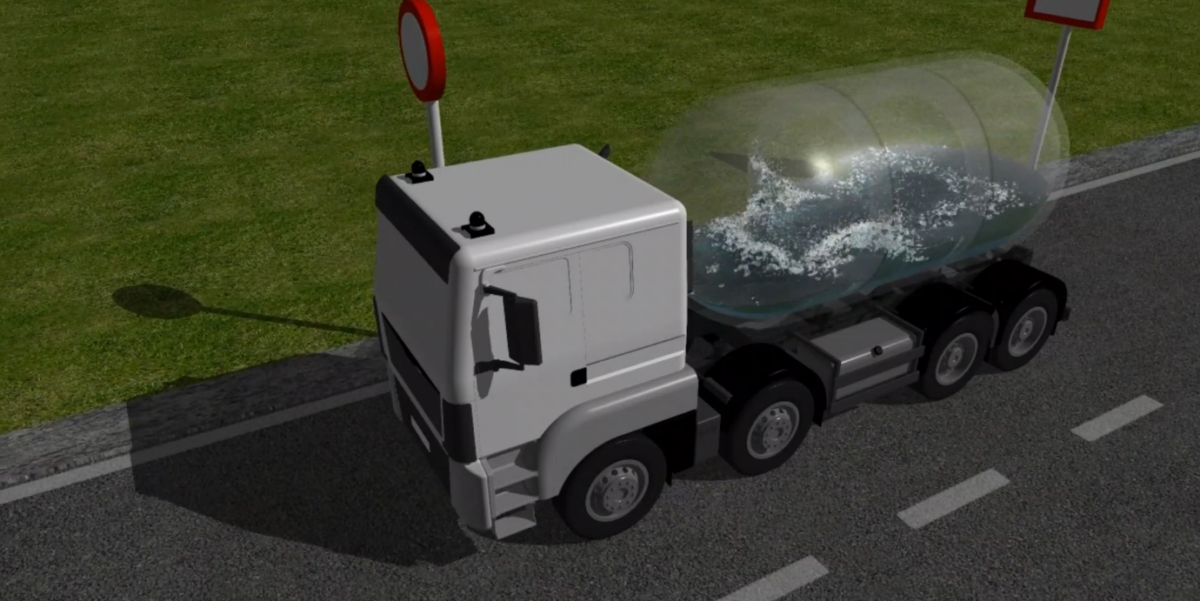
Figure 1: Tank sloshing during dynamic driving conditions.
Fill levels and driving conditions significantly influence the intensity of sloshing. Simulations can assess how different driving conditions, such as acceleration, braking, and cornering, affect fluid dynamics within the tank. This information is crucial for developing guidelines and strategies to reduce the adverse effects of sloshing.
In PreonLab, fill levels and driving conditions can be easily defined and adjusted. Fill levels can be modified using volume sources or by specifying the desired fluid volume. For driving conditions, PreonLab features a user-friendly keyframe editor that allows for the precise definition of even the most complex driving dynamics. Additionally, external vehicle data can be imported, making the configuration process intuitive and straightforward.
Video 3: Tank Sloshing During Accelerating, Decelerating and Cornering Maneuvers on a Racetrack.
Capturing all relevant physical phenomena is essential for accurate simulation results. In tank sloshing analysis, which typically involves two fluids, such as fuel and air, multiphase capability becomes a key factor. Depending on the specific goals of the analysis, you can simulate tank sloshing with or without the air phase. Excluding the air phase reduces simulation time but may alter fluid flow distribution. When multiphase capability is needed, PreonLab’s CSS (Continuous Surface Stress) surface tension model effectively simulates high-density ratio fluids. The liquid and air phases are discretized separately using particles of varying sizes, ensuring both efficiency and accuracy in multiphase simulations.
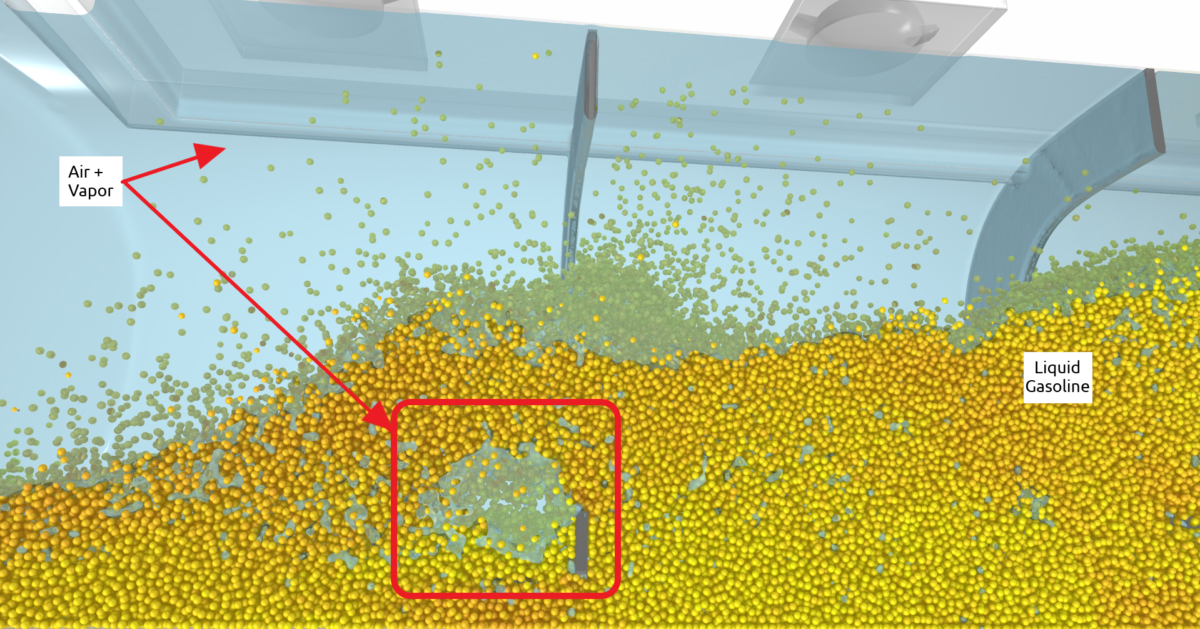
Figure 2: Pocket of air and gasoline vapor mixture (transparent light blue) entrapped in the sloshing liquid gasoline (yellow particles).
Intensive sloshing can exert substantial forces on the tank walls and internal structures, leading to potential stresses and deformations. Understanding these effects is crucial for designing tanks that can withstand the dynamic forces of the moving fluid, ensuring long-term durability and safety. If not properly addressed, these stresses and deformations can result in structural failures, leaks, and compromised tank integrity, ultimately impacting vehicle performance and safety.
While PreonLab does not directly enable structural analysis, it provides the necessary inputs for such simulations. These inputs can be exported and used in third-party tools to perform detailed structural analyses. Specifically, PreonLab allows for the export of forces and pressure data in .csv format, which can then be used for coupling with structural analysis software.
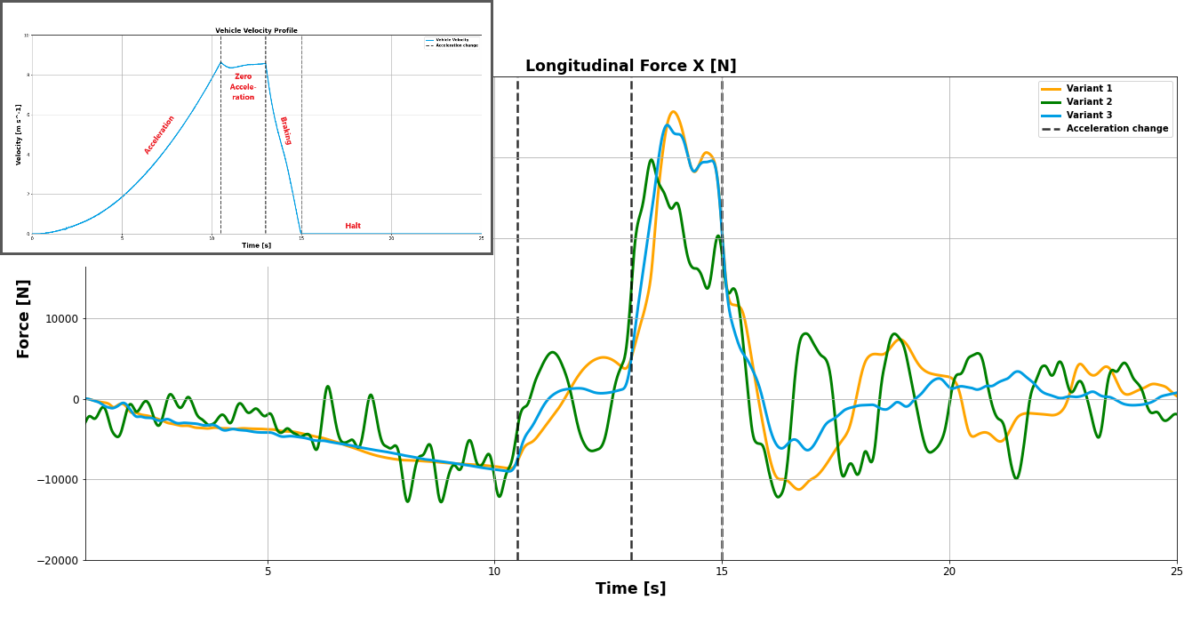
Figure 3: Plot showing the total longitudinal sloshing force acting on different tank designs, simulated in PreonLab.
With PreonLab, users can visualize details of the fluid flow like the fluid velocity or particle trajectory with the help of the Pathlines Sensor.
The Pathlines feature visualizes the path traveled by selected particles, along with their velocity magnitude over time.
Pathlines can be especially useful for analyzing sloshing simulations, such as the one shown in the video, to help assess the effects of baffles and dampers on fluid flow.
Video 4: Visualizing the flow of the sloshing fluid using the Pathlines Sensor in PreonLab.
Tank sloshing is a critical aspect of vehicle design that requires accurate analysis. By leveraging PreonLab’s pure particle-based method, engineers can efficiently simulate the complex fluid dynamics within fuel tanks. With minimal pre-processing, an intuitive interface, and streamlined workflows, PreonLab enhances the virtual development process, resulting in safer, more durable tanks that optimize vehicle performance and fuel efficiency across various driving conditions.