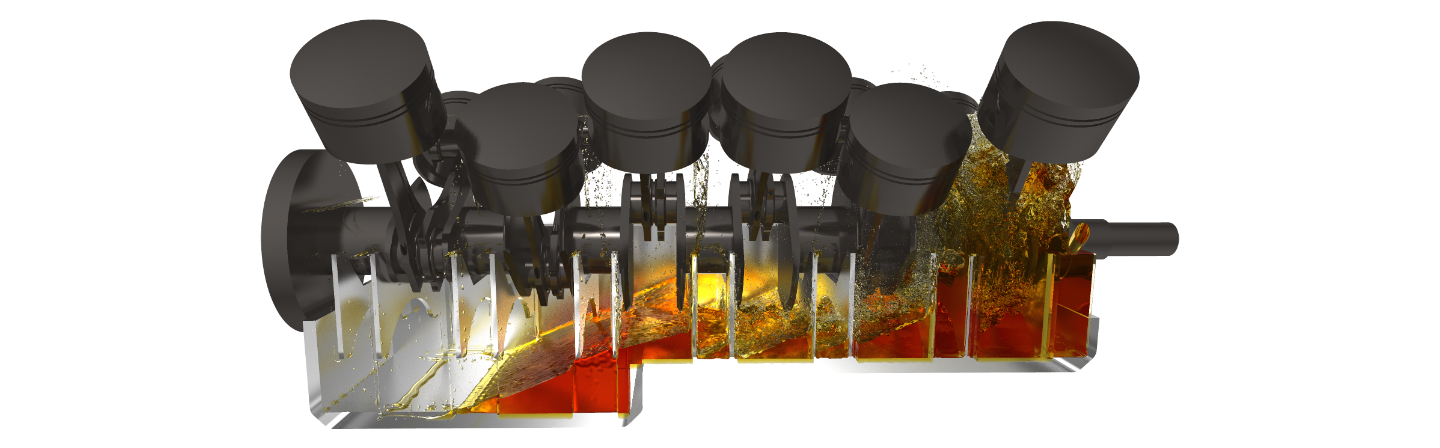
Ensuring a consistent supply of oil to critical components is essential for efficient operation and longevity of internal combustion engines. However, during dynamic driving conditions such as acceleration, braking, and cornering, the movement of oil within the crankcase – commonly known as sloshing – can pose significant challenges. Uneven oil distribution due to sloshing may lead to inadequate lubrication in certain areas inside the crankcase, which could lead to premature wear and potential engine failure, while also impacting overall engine efficiency. Understanding and managing oil sloshing in engine design is crucial for reliable engine operation under various conditions.
Particle-based CFD software like PreonLab offers clear advantages over conventional mesh-based methods for investigating the oil distribution in crankcases. Unlike traditional CFD methods, PreonLab uses a pure-particle approach, eliminating the need for time-consuming surface preparations or meshing. This makes this method very suitable for crankcase simulations which involve many geometric features. PreonLab also handles kinematics with ease, accurately predicting oil distribution during dynamic driving maneuvers. Its user-friendly interface facilitates quick setup of complex simulations, ensuring efficient engine design optimization.
Using PreonLab, engineers can gain critical insights by virtually simulating and optimizing different crankcase configurations. This enables efficient evaluation of baffling strategies and partition designs, along with detailed analysis of flow quantities, lubrication efficiency, flow uniformity, and overall design performance under various driving conditions.
PreonLab facilitates the optimization of crankcase configurations. Engineers can iteratively test different design strategies and evaluate designs virtually, assessing their effectiveness in minimizing crankcase sloshing and the related issues. Model updates and changes are just a few mouse clicks away, eliminating the need for labor-intensive tasks such as re-meshing and surface preparation. This virtual prototyping capability reduces the need for costly physical prototypes and accelerates the development cycle, ensuring that the final engine design is robust against sloshing effects.
Video 1: Crankcase sloshing during acceleration and braking.
One of the benefits of using PreonLab is the availability of handy postprocessing sensors. These sensors are very intuitive to use for post-processing tasks. They play a crucial role in measuring forces, assessing quantities such as oil, volume and velocity. They can also measure accumulated wetting exposure, instantaneous wetting and several other quantities. This capability provides detailed insights into how oil behaves within the crankcase during real-world scenarios. By correlating simulation results with empirical data, PreonLab can be used to validate design modifications aimed at enhancing oil distribution uniformity and reducing mechanical losses due to frictional resistance.
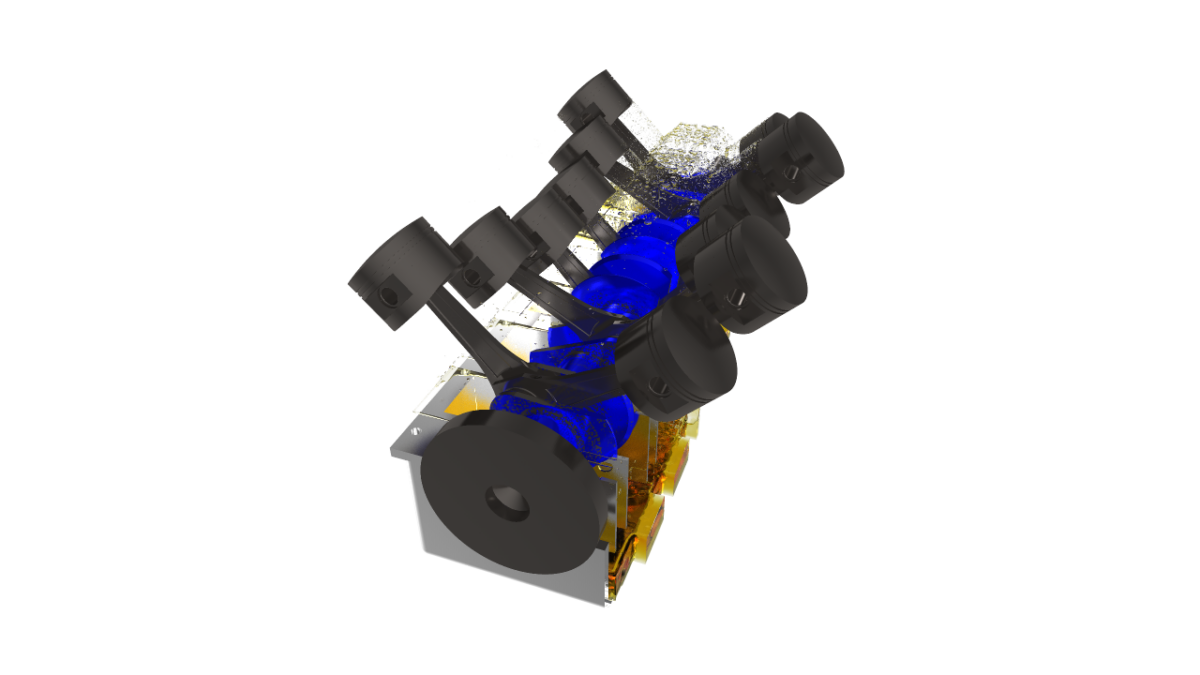
Figure 1: Oil wetting analysis of the crankshaft.
Beyond virtual insights, PreonLab’s utilization translates into tangible benefits for engine development and performance. One key application lies in enhancing engine reliability by optimizing the baffling system to maintain a consistent oil supply under all driving conditions. By simulating various scenarios, such as sudden acceleration of the car followed by sharp braking, engineers can predict and mitigate potential oil starvation areas before physical testing, thereby reducing the overall cost of the design phase of ICEs.This iterative process not only reduces time-to-market but also enhances the competitiveness of engine designs in terms of performance and reliability.
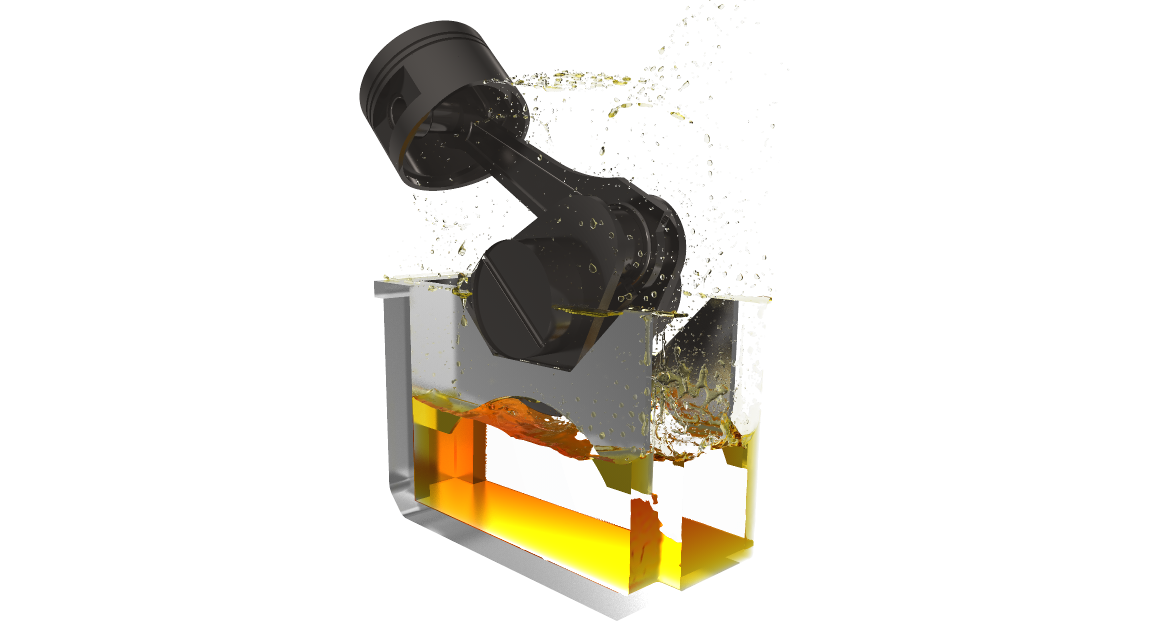
Figure 2: Isolated view of a piston within a crankcase during a dynamic driving maneuver.
In conclusion, particle-based CFD software, like PreonLab, offers significant advantages for crankcase oil sloshing simulations. PreonLab accurately predicts oil distribution during dynamic driving maneuvers without extensive surface preparations and enables efficient optimization of crankcase configurations. Engineers can virtually prototype and test various baffling strategies and partition designs, reducing reliance on costly physical prototypes and accelerating development cycles.
For those interested in exploring how PreonLab can enhance engine reliability and efficiency through advanced simulation capabilities, contact us to learn more.
For more information on how PreonLab can help tackle your simulation challenges, get in touch with us here.